How to get your first 100 users for a new app
Your first 100 users won't come from ads or the store algorithm. Here is a practical, step-by-step way to find them one by one and learn from every one.
· 5 मिनट में पढ़ें
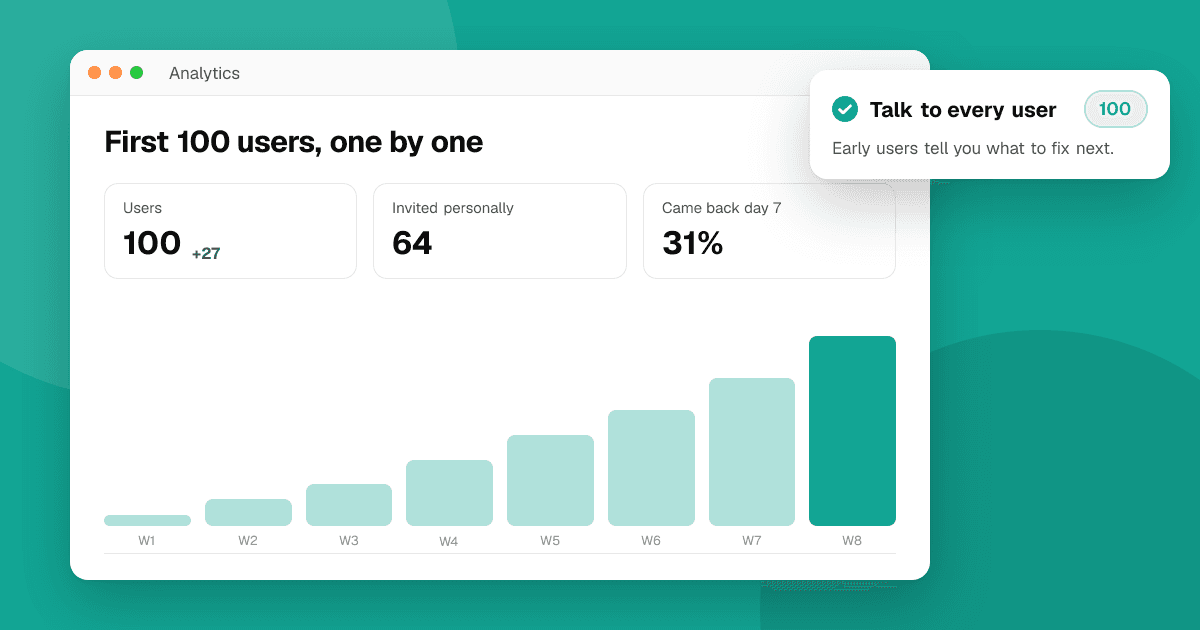
Short answer: your first 100 users come from doing things that don't scale. Write down exactly who the app is for, go to the places those people already talk, and invite them personally, a few at a time. Talk to every early user, fix what they trip over and ask them who else should try it. Ads, store search and press come later, once you know the app keeps the people who try it.
Why are the first 100 users different?
The first 100 users are not about growth. They are about learning. With a hundred real people you can see:
- whether people understand what the app does from the store page,
- where they get stuck in the first session,
- whether anyone comes back the next day or the next week,
- which kind of person loves it, and which kind leaves.
That is why it's fine, even better, to find them by hand. A user you invited personally will tell you what's wrong. A user from an ad usually just leaves.
Step 1: Who exactly is the app for?
"Everyone with a phone" is not an answer. Write one sentence like:
"Freelance designers who send invoices every month and hate spreadsheets."
A specific sentence tells you where to look (design communities, freelancer forums), what to say (stop fighting spreadsheets) and who to ignore for now. You can widen the audience later.
Step 2: Where do those people already hang out?
Make a list of 10 to 20 specific places. For example:
- Subreddits and forums about the problem your app solves, not only app or developer subreddits.
- Discord and Slack communities for that hobby, profession or game genre.
- Facebook groups, Telegram or WhatsApp communities, which are big in many countries.
- People you already know who fit the description: colleagues, classmates, friends of friends.
- Newsletters and small creators who write for that audience.
Read each community's rules before posting. Many ban self-promotion outside a weekly thread; respect that, or you'll be removed and remembered for the wrong reason.
Step 3: How do I invite people without spamming?
Be a member before you're a marketer. In practice:
- Help first. Answer questions in the community for a while. People notice who is useful.
- Share the story, not the pitch. "I kept losing invoices, so I built a tiny app for it. Looking for 10 freelancers to try it and tell me what's missing" works much better than "Download the best invoicing app!".
- Ask for feedback, not downloads. People like being asked for an opinion. Give them a clear, small task.
- Message people one by one when someone describes the exact problem your app solves, and only where direct messages are welcome.
- List the app where people go to find new apps. On TrueLaunch you can list it for free from a Google Play or App Store link, and people who like trying new things leave structured reviews: what worked, what could be better and which bugs they found.
Track every invite in a simple sheet: where, when, how many tried it. After two weeks you'll see which places actually work.
Step 4: How do I turn early users into feedback?
Every one of your first 100 users is a potential interview.
- Say thank you personally to each new user if you can, by email or in the community where they found you.
- Ask one question: "What almost made you give up?" or "What did you expect that wasn't there?"
- Watch the first session for a few people, on a call with screen sharing. You'll learn more in 20 minutes than from a week of analytics.
- Reply fast to bug reports and ship fixes quickly. Early users forgive bugs; they don't forgive silence.
Our guide on getting honest feedback on your app has the questions that get useful answers.
Step 5: How do I know the app is ready to grow?
Watch retention, not downloads. If people who try the app keep coming back after a day, a week and a month, you have something worth growing. If most leave after the first session, more users won't fix it. Go back to steps 2 to 4 and learn why.
Signs you're ready for more:
- people use it without you reminding them,
- some users tell friends without being asked,
- the same requests repeat, so you know what to build next.
Step 6: How do early users bring the next ones?
Once a few people like the app, make sharing easy:
- Ask happy users who else should try it. A simple "Do you know another freelancer who'd like this?" works.
- Add a share option where it makes sense, like sharing a result, a level score or a finished document.
- Build in public. Post short updates about what you changed because of user feedback. It brings new people and shows existing users you listen.
- Plan a launch day once the app is stable. Read how to launch an indie mobile game; most of the checklist works for apps too.
What should I avoid?
- Buying installs or reviews. It gives you numbers, not users, and it breaks the store rules.
- Asking for store ratings in exchange for anything, like features or giveaways. Both Google Play and the App Store forbid incentivized ratings.
- Spamming the same link everywhere. One thoughtful post in the right place beats fifty copy-pasted ones.
- Building more features before you learn why people leave. More features rarely fix a confusing first session.
Next steps
Write your one-sentence audience today, list ten places where those people are, and invite five of them by the end of the week. At the same time, list your app on TrueLaunch so people who enjoy discovering new apps can find it and tell you what they think.
Frequently asked questions
How long does it take to get the first 100 users?
It varies a lot by app and audience. Many indie developers get there in a few weeks of steady, personal outreach. The point is to learn from those users, so speed matters less than talking to them.
Should I pay for ads to get my first users?
Usually not yet. Ads bring people who don't know you and rarely give feedback. Find your first users by hand, learn why they stay or leave, and spend on ads once people who try the app keep using it.
Is it okay to ask friends and family to use my app?
Yes, as a start, but don't treat their opinion as proof. Friends are polite. Strangers from your target audience tell you much more about whether the app works.