How to promote your app for free: 12 ideas that actually work
No marketing budget? Here are practical, free ways to promote an app or game: communities, content, short video, launch boards and your store listing.
· 5 मिनट में पढ़ें
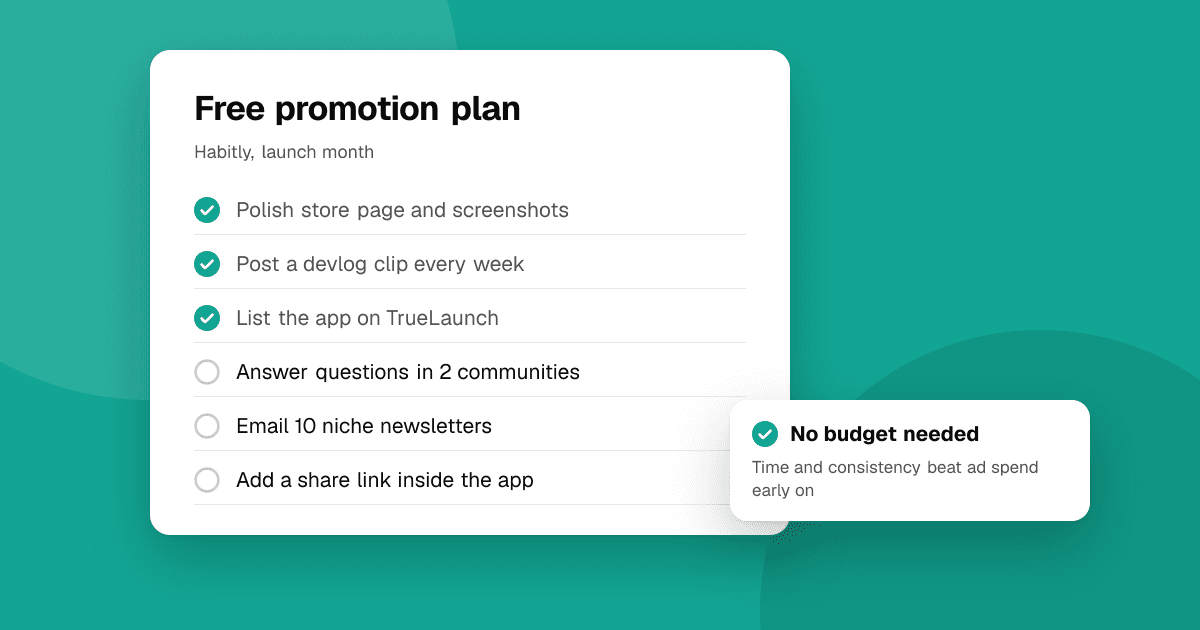
Short answer: free promotion costs time instead of money, so spend that time where your users already are. Polish your store listing first, then share your story in the right communities, post short videos of the app in use, list it on discovery sites and launch boards, and turn early users into people who tell others. Pick three or four ideas from the list below and do them consistently rather than trying everything once.
Before you promote: is the store page ready?
Every free channel sends people to your store page, so fix that first. If the page doesn't explain the app in a few seconds, the rest of your effort leaks away.
- Icon that is simple and readable at small sizes.
- First two screenshots that show the main benefit with a short caption.
- First lines of the description that say what the app does and for whom.
Our guides on app store optimization and screenshots and icons that convert go deeper.
Which free channels work best?
1. Communities about your app's topic
The best audience is people who have the problem your app solves. A budgeting app belongs in personal finance communities; a word game belongs where word game players talk. Help first, read the rules, then share your story and ask for feedback.
2. Developer and maker communities
Other developers are great for honest feedback and early support, and many communities have regular "show your project" threads. Remember they are not always your target users.
3. App discovery sites and launch boards
People visit these sites specifically to find new apps and games. You can list your app on TrueLaunch for free from a Google Play or App Store link. People review it by answering what worked, what could be better and which bugs they found, and you can pick a launch day to appear on the launches board, ranked by that day's upvotes.
4. Short videos
TikTok, YouTube Shorts and Instagram Reels reward interesting clips, not big brands. Film the app solving a real problem or a satisfying moment in your game. Start with the result in the first second, keep it short, and post regularly.
5. Build in public
Share what you're working on: a new feature, a hard bug, a number you're proud of, a mistake you learned from. Posting progress on X, LinkedIn, Bluesky or Threads builds an audience that wants you to succeed.
6. Write helpful content
Write about the problem your app solves, not about the app itself. A guide like "how to split rent fairly with roommates" can bring people from search for years, and the app is the natural next step.
7. Answer questions
When someone asks "is there an app that does X?" on a forum, Reddit or Quora, and your app really does X, answer honestly and say you made it. Don't do this where the question isn't really about your app.
8. Email and personal messages
Message people you know who fit the target audience, one by one, with a personal note. A short personal email still beats any broadcast.
9. Small creators and newsletters
Creators and newsletter writers with smaller audiences often reply, and their followers trust them. Offer a free full version or early access so they can try it properly. Don't require a positive review in return.
10. Cross-promotion with other developers
If you know a developer with a related but non-competing app, mention each other's apps in a newsletter, an in-app "more from friends" screen or social posts. Keep it honest and relevant for both audiences.
11. Local and niche press
Local news sites, university newsletters and niche blogs like stories about local makers or a specific hobby. A short, personal pitch with a clear angle ("student builds app to find free study rooms") works better than a press release.
12. Your existing users
Happy users are your best channel. Make sharing easy, thank people who recommend you, and ask "who else would like this?" Never reward store ratings, but you can simply ask happy users to tell a friend.
How do I choose which ideas to use?
Don't try all twelve at once. Pick based on where your audience is:
| If your users are... | Start with |
|---|---|
| Professionals | LinkedIn, newsletters, helpful content, niche communities |
| Gamers | Short videos, Discord, Reddit, launch boards, small creators |
| Students | Short videos, campus groups, local press |
| Other developers | Developer communities, build in public, launch boards |
Then track what works. A simple sheet with "where, when, how many visits or installs" is enough. After a month, double down on the two best channels and drop the rest.
What should I never do?
- Never buy installs, reviews or ratings. It's against store rules and gives you fake numbers.
- Never offer rewards for store ratings, and never ask for a specific number of stars.
- Never trade ratings with other developers. Rating swaps are against store rules and tell you nothing.
- Never spam communities. Getting banned from the best community for your audience is expensive.
Next steps
Fix your store page, pick three channels from this list and commit to them for four weeks. A good first step today: submit your app to TrueLaunch and read how to get your first 100 users.
Frequently asked questions
What is the best free way to promote an app?
Usually the communities where your target users already talk, combined with a strong store page. Short videos work well for visual apps and games, and discovery sites help people who like trying new apps find you.
Can I promote my app by offering rewards for reviews?
No. Google Play and the App Store forbid rewarding ratings or reviews. Ask for honest feedback instead, and let happy users recommend the app on their own.
How long does free promotion take to work?
Expect weeks, not days. Free channels build up over time, so pick a few and stay consistent for at least a month before judging them.