Unity, Godot or Unreal? How to choose a game engine for a mobile indie game
Choosing a mobile game engine as an indie developer: compare Unity, Godot, Unreal, GameMaker and Defold on cost, licensing, 2D and 3D, build size and mobile export.
· 3 min read
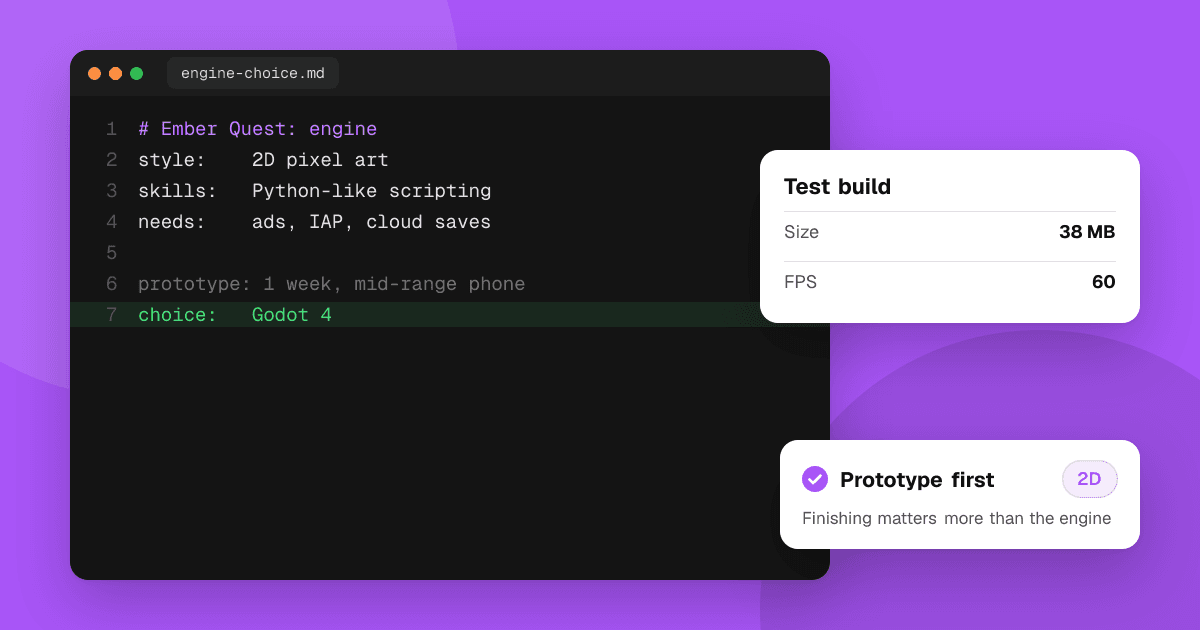
Short answer: for most mobile indie games, Unity and Godot are the safest choices. Unity has the largest ecosystem for mobile ads, purchases and services; Godot is free and open source, light, and excellent for 2D. Unreal shines for high-end 3D but makes large builds that are harder to run on cheaper phones. GameMaker and Defold are strong for small 2D games. Pick the engine you or your team already know unless it truly can't make your game; finishing matters more than the engine.
What matters most for mobile?
- Build size and startup time: many players on slower networks skip large downloads. See how to reduce app size and startup time.
- Performance on mid-range phones, not just your own.
- Mobile services: ads, in-app purchases, push notifications, cloud saves and analytics, usually through plugins or SDKs.
- Export to Android and iOS, including signing and store requirements.
- License and cost as your game grows.
Unity
The most used engine for mobile games. Strengths: a huge asset store, tutorials for nearly everything, and mature SDKs from ad networks and analytics providers. It handles 2D and 3D well. Unity cancelled its controversial runtime fee in 2024; the free Personal plan covers small studios under a revenue threshold, and paid plans apply above it. Check Unity's current pricing page before you commit. Building for iOS needs a Mac with Xcode.
Good for: most 2D and 3D mobile games, especially ad- or purchase-funded ones.
Godot
Free and open source under the MIT license: no fees or royalties. The editor is small and fast, 2D support is excellent, and 3D has improved a lot in Godot 4. Exports to Android and iOS are built in (iOS export needs a Mac). Mobile ads and purchases rely on community or official plugins, so check that the services you need are supported and maintained.
Good for: 2D games, small 3D games, developers who want no licensing worries.
Unreal Engine
Top-tier 3D graphics, with source access. Free to start; Epic charges a royalty on gross revenue above a lifetime threshold per game, so read the current EULA. On mobile, builds are large and demanding, which limits your audience on lower-end Android phones. It's a heavy choice for a solo developer's first mobile game.
Good for: ambitious 3D games aimed at high-end phones, teams already skilled in Unreal.
GameMaker and Defold
- GameMaker: fast for 2D games, with a friendly workflow. Mobile export requires a paid license tier; check current plans.
- Defold: a free, lightweight engine with small builds and good mobile performance, maintained by the Defold Foundation. Smaller community, but popular for casual and hyper-casual 2D games.
What about frameworks like Flutter?
For simple puzzle, word or card games, a general app framework (Flutter with the Flame engine, for example) can work well and makes non-game screens easy. For action games with physics and lots of sprites, a game engine saves time.
How do I choose quickly?
- 2D or 3D? 2D: Godot, Unity, GameMaker or Defold. 3D: Unity or Godot; Unreal for high-end.
- What do you already know? C#: Unity or Godot. Python-like scripting: Godot's GDScript. Lua: Defold. C++: Unreal.
- Which services do you need? List ads, purchases and analytics, and check each engine's plugins.
- Build a one-week prototype of your core mechanic, export it to a mid-range Android phone and an iPhone, and check size and frame rate.
Next steps
Prototype the core loop first; see from game jam prototype to mobile release and how to find playtesters for your indie game. When you have a playable build, list your game on TrueLaunch for free and get honest feedback from other developers.
Frequently asked questions
What is the best game engine for mobile indie games?
Unity and Godot suit most mobile indie games. Unity has the biggest mobile ecosystem; Godot is free, open source and especially good for 2D. Choose the one you already know if possible.
Is Godot good for mobile games?
Yes, especially for 2D. It exports to Android and iOS, has no fees or royalties, and keeps builds fairly small. Check plugin support for the ads and purchases you need.
Does Unity still have a runtime fee?
No. Unity cancelled the runtime fee in 2024. The free Personal plan covers small studios under a revenue threshold; check Unity's pricing page for current limits.
Is Unreal Engine good for mobile?
It can make impressive mobile games, but builds are large and demanding, which limits reach on cheaper phones. It's best for high-end 3D games and teams that already know it.