How to balance game difficulty so players stay hooked
Too easy is boring, too hard makes players quit. Learn how to balance difficulty in a mobile game with playtests, simple data, difficulty curves and options.
· 4 min de lectura
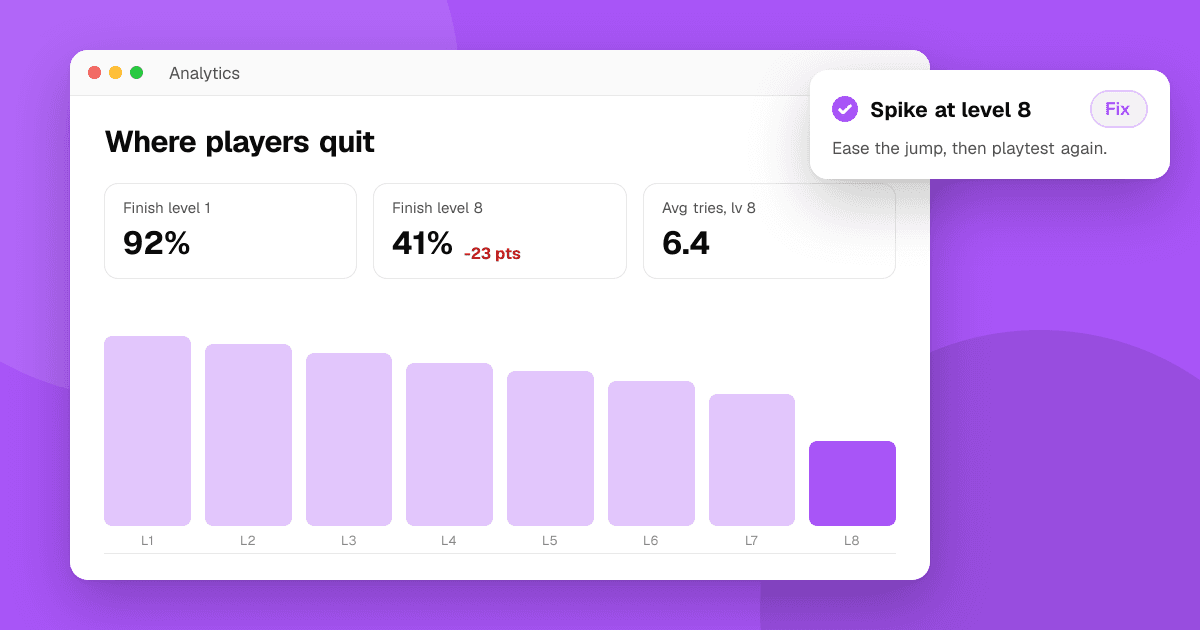
Short answer: balance difficulty by watching where real players fail and quit, not by guessing. Design a curve that rises with small breathers, teach each new idea before testing it, and make failure cheap and fast to retry. Measure a few simple numbers (attempts per level, where players stop) and adjust in small steps. Offer options for players who want it easier or harder, and remember that you, the developer, are the worst judge of difficulty because you know every trick.
Why is difficulty so hard to judge yourself?
You have played your game hundreds of times. Levels that feel trivial to you can stop a new player completely. That's why every difficulty decision should come from people seeing the game for the first time. Watch them play without helping, and note:
- where they hesitate or look confused
- where they fail, and how many times
- where they stop playing
What does a good difficulty curve look like?
Not a straight line up. A good curve is a staircase with rests:
- Introduce a new mechanic in a safe situation where failure is unlikely.
- Develop it with a few levels that use it in slightly harder ways.
- Test it with a challenge that combines it with things the player already knows.
- Rest with an easier level or two before the next new idea. A breather after a hard level feels rewarding and stops fatigue.
Early levels should almost always succeed. The goal of the first minutes is confidence; the challenge comes once players care about the game.
How do I make failure feel fair?
Players accept hard games when failure feels like their mistake, not the game's. Check these:
- Clear feedback. The player should know why they failed. Show what hit them or which move was wrong.
- Fast retries. One tap back into the action. Long reload screens turn a fun challenge into frustration.
- Short checkpoints. Losing ten minutes of progress for one mistake makes people quit on mobile.
- Readable threats. Enemies and hazards telegraph what they will do before they do it.
- Consistent rules. If something works once, it should work the same way every time.
Which numbers should I track?
You don't need a complex analytics setup. A few counts per level tell you most of what you need:
- Attempts per completion. How many tries it takes on average. A sudden jump marks a difficulty spike.
- Completion rate. What share of players who start a level finish it.
- Where players stop. The last level reached before people stop playing. A cluster on one level is a red flag.
- Time per level. Very long times can mean confusion rather than challenge.
Collect only what you need, without identifying players, and follow your privacy policy and any consent rules in your players' countries.
How do I adjust difficulty safely?
- Change one thing at a time (enemy speed, timer, number of moves), then test again. Changing five numbers at once hides which one helped.
- Make small steps. A 10 to 20 percent change is often enough to move a level from frustrating to fair.
- Fix spikes by reordering first. Sometimes a hard level is fine; it's just too early. Moving it later can solve the problem without touching numbers.
- Keep a tuning sheet. Put every important number in one place, outside the code if you can, so you can adjust without hunting through scripts.
Should I offer difficulty options?
Often, yes. Different players want different things:
- Difficulty modes (story, normal, hard) let players pick their challenge up front.
- Assist options like slower speed, extra hints or longer timers help players who are stuck without changing the game for others.
- Optional challenges such as bonus objectives, time trials or hard-mode levels give skilled players something to chase.
- Hints after repeated failure can appear quietly after a few failed attempts. Let players turn them off.
Avoid making the game harder on purpose to push purchases. Players notice, and it damages trust and reviews quickly.
How do I test difficulty with players?
- Recruit people who match your target player and have never seen the game.
- Give them a fixed task, like "play the first 15 levels".
- Watch silently, or ask them to record their screen and think out loud.
- Afterwards ask: where did you feel stuck? Where was it too easy? Where did you want to stop?
- Compare their experience with your numbers, change one thing and test again with new players.
Next steps
Pick the level where most players stop, watch three new players try it, and make one small change. For more on getting players to test, read how to find playtesters for your indie game, and when you want feedback from a wider group, list your game on TrueLaunch, where reviewers tell you what worked, what could be better and which bugs they found.
Frequently asked questions
How do I know if my game is too hard?
Watch new players. If many fail the same level repeatedly, take a long time on it or stop playing there, that level is too hard or too early in the game.
Should mobile games have difficulty settings?
It helps many games. Modes and assist options let players choose the challenge they enjoy, while optional challenges give skilled players more to do.
What is a difficulty spike?
A point where the game suddenly gets much harder than what came before. You can spot it when attempts per completion jump or many players stop at the same level.