Should you launch on Android or iOS first? How indie developers decide
Android or iOS first? Compare audience, revenue, costs, testing rules and review times, then pick the right first platform for your app or game with a simple checklist.
· 4 min read
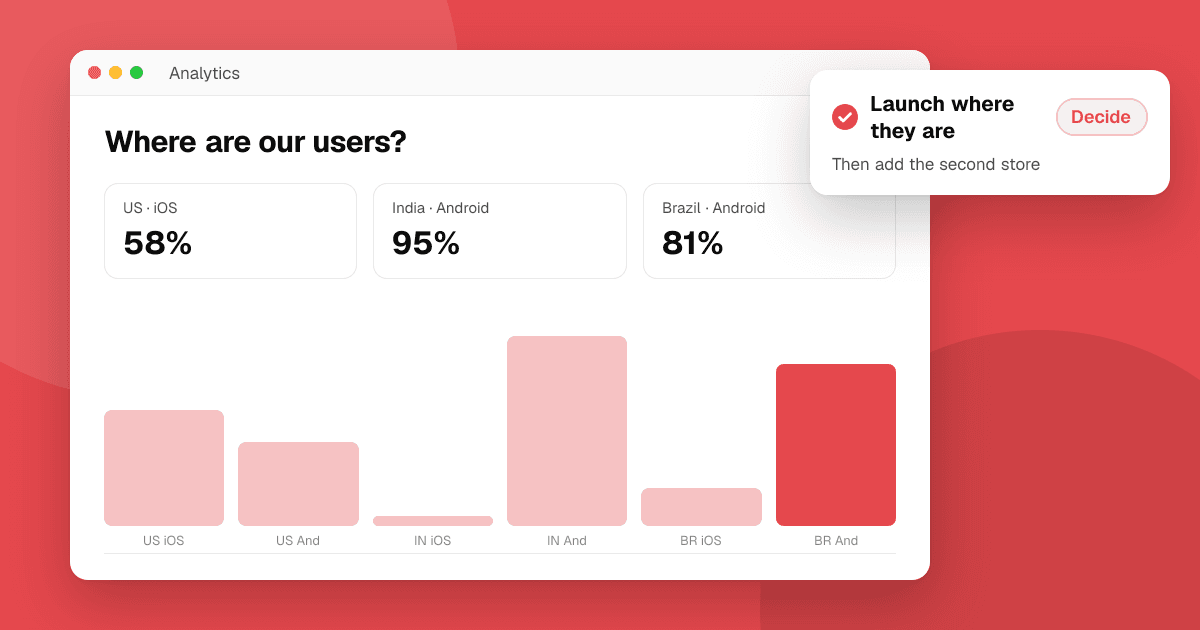
Short answer: launch first where your audience is and where you can ship and support well. iOS often earns more per user and leads in the US, Japan and much of Western Europe. Android has far more users worldwide and leads in India, Indonesia, Brazil and most of Africa and Latin America. If you build with a cross-platform framework and can test on both, launching on both at once is fine. If you can only do one well, pick the platform your target users carry and the one you can test on daily.
Who uses Android and who uses iOS?
Worldwide, roughly seven in ten smartphones run Android. The split changes a lot by country:
- iOS-heavy: the United States, Canada, Japan, the UK, Australia and the Nordic countries, where iPhones hold around half the market or more.
- Android-heavy: India, Indonesia, Brazil, Mexico, Nigeria, Turkey and most of Southeast Asia, where Android is often above 80%.
Check a current source such as StatCounter for your target countries before you decide. Your audience matters more than global numbers: a tool for US designers and a game for students in India have very different answers.
Which platform earns more?
People spend more money in the App Store than on Google Play, even though Google Play has more users and downloads. That makes iOS attractive for paid apps and subscriptions. Android is strong for apps that earn from ads, need a large audience, or target countries where iPhones are less common. See how to monetize a free app and in-app purchases vs subscriptions.
What does each platform cost to start?
- Google Play: a one-time $25 registration fee. New personal accounts must run a closed test with at least 12 testers for 14 days before going to production; see how to get 12 testers for Google Play closed testing.
- App Store: $99 per year for the Apple Developer Program, and you need a Mac to build and upload iOS apps (or a cloud build service).
Both take a commission on digital sales, with reduced rates for small developers. Details are in Google Play and App Store fees explained.
How do testing and review differ?
- iOS: fewer devices to support and TestFlight makes beta testing easy, but every build goes through App Review. Most reviews finish within a day or two; see how long App Store review takes.
- Android: thousands of device models and screen sizes, older OS versions in use, and the testing-track requirement for new personal accounts. Plan to test on several real or cloud devices: testing on many Android devices.
When should I launch on Android first?
- Your audience is mostly in Android-heavy countries.
- You earn from ads or need many users quickly.
- You don't have a Mac or an iPhone to test on.
- You want to run a longer public beta with open testing.
When should I launch on iOS first?
- Your audience is in the US, Japan or other iOS-heavy markets.
- You plan to charge for the app or a subscription.
- You build natively in Swift or need Apple-only features such as widgets, Live Activities or Apple Watch.
- You want a smaller, more uniform set of devices for your first release.
Should I launch on both at once?
If you use Flutter, React Native or another cross-platform tool (how to choose a framework), shipping both is mostly extra testing and two store listings. It doubles your audience at launch and avoids "when is it coming to Android?" questions. The cost is support: two review processes, two sets of device bugs and two listings to keep updated. If you're a solo developer with limited time, a strong launch on one platform beats a shaky launch on two.
A simple way to decide
- Write down the three countries where most of your target users live.
- Look up the iOS and Android share in each.
- Decide how you'll earn money (ads, purchases, subscriptions).
- Check which devices you own and can test on daily.
- Pick the platform that wins at least three of these, and add the second within a few months if early users ask.
Next steps
Whichever you pick first, get early feedback before you go wide. List your app on TrueLaunch for free; you can add the second store link later and one listing covers both. Then follow the app launch checklist.
Frequently asked questions
Is it better to launch on Android or iOS first?
Launch where your target users are and where you can test well. iOS usually earns more per user and leads in the US and Japan; Android has more users worldwide and leads in India, Indonesia and Brazil.
Do iOS users spend more than Android users?
Yes, on average. Consumer spending in the App Store is higher than on Google Play, even though Google Play has more users and downloads.
Do I need a Mac to publish an iOS app?
You need macOS and Xcode to build and upload iOS apps, either on your own Mac or through a cloud build service.
Is it cheaper to publish on Android?
Yes. Google Play charges a one-time $25 fee, while the Apple Developer Program costs $99 per year. New personal Google Play accounts must also complete a 14-day closed test first.