How to build and launch an app while working a full-time job
A realistic plan for building an app on nights and weekends: scope it small, protect a weekly schedule, check your employment contract and ship within three months.
· 4 min read
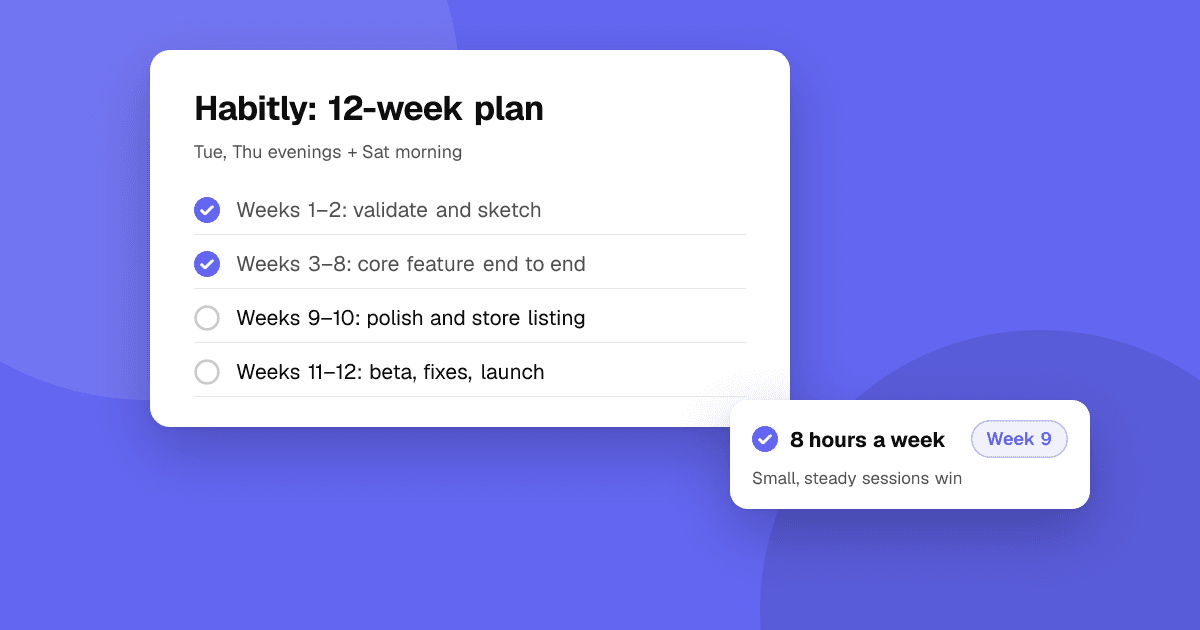
Short answer: most indie apps are built on nights and weekends. What works is a small scope, a fixed weekly schedule you can keep for months, and a public deadline. Aim to ship a first version in about 12 weeks with 6 to 10 focused hours a week. Before you start, check your employment contract for rules about side projects and who owns what you build. Then cut features until the plan fits the time you really have.
How much time do I really have?
Be honest. After work, family and rest, many people have one or two evenings and one weekend block a week: about 6 to 10 hours of real focus. Plan with that number, not the 20 hours you hope for. Consistency beats intensity; three steady sessions a week beat one exhausting weekend a month.
Check your contract first
Many employment contracts include clauses about outside work, competing products or intellectual property created while employed. Some are broad enough to cover work done on your own time. Read yours, avoid using your employer's laptop, accounts or code, and don't build something that competes with your employer. If anything is unclear, ask HR in writing or talk to a lawyer. This isn't legal advice.
Scope it to 12 weeks
Write the one problem your app solves and list every feature you imagine. Then keep only what's needed to solve that problem once, well. A useful test: if a feature takes more than one week of your time, it waits for version 2. Our guide to validating an app idea helps you find what matters before you build.
A rough 12-week plan:
- Weeks 1–2: validation, sketches and project setup.
- Weeks 3–8: the core feature, end to end, ugly at first.
- Weeks 9–10: polish, onboarding, store listing and screenshots.
- Weeks 11–12: beta test, fixes and launch.
How do I keep going when I'm tired?
- Fixed sessions: the same evenings each week, in your calendar like a meeting.
- Leave a note: end every session by writing the very next step. Starting is the hardest part when you're tired, and a clear next step removes it.
- Small wins: break work into tasks of under an hour so every session finishes something.
- Low-energy tasks: keep a list for tired nights: icons, copy, bug fixes, store text.
- Build in public: short weekly updates on social media or a newsletter create gentle accountability and early followers. See how to build an email list before you launch.
What should I avoid?
- Rewriting the stack halfway through. Use tools you know; see how to choose a framework.
- Building your own backend when a hosted service would do.
- Polishing before testing. Put a rough build in front of five people early.
- Starting a second idea before the first ships.
- Giving up sleep. Burnout ends more side projects than bugs do.
How do I launch with limited time?
Keep launch simple: one store first (Android or iOS first?), a landing page, a short launch post and a few communities where your users already are. Schedule launch for a time you can answer feedback within a day, such as the start of a weekend.
What about support after launch?
Set expectations: a support email, an FAQ and replies within a few days are enough for a small app. Batch support into one session a week. See how to handle app support as a solo developer.
Next steps
Pick your launch date now, 12 weeks out, and write it somewhere public. When you have a first build, list it on TrueLaunch for free and schedule a launch day: other developers will try it and tell you what works and what to improve.
Frequently asked questions
How long does it take to build an app part time?
A focused first version often takes about three months at 6 to 10 hours a week. Larger apps take longer, which is why cutting scope matters most.
Can my employer own the app I build on my own time?
Possibly, depending on your contract and local law. Read the outside-work and intellectual property clauses, avoid using company equipment or code, and ask HR or a lawyer if unsure.
How many hours a week should I spend on a side project?
What you can keep up for months. For most people with a full-time job that's 6 to 10 focused hours, spread over three or four sessions.
How do I stay motivated on a side project?
Use fixed sessions, end each one with a note about the next step, ship small tasks, share progress weekly and put a public launch date in place.